From HDR radiance to diffuse lighting
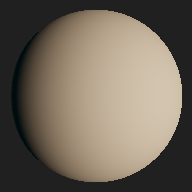

These existing 192×192 PNGs come from the complete CPU-only HDR reference workflow. An asymmetric procedural linear HDR environment has a prominent feature along (0.8,0,0.6). Pixel-center latitude-longitude quadrature projects it into canonical RGB L2 SH coefficients. Analytical active +90° Z rotation moves the feature toward +Y: f_rotated(d)=f_original(R⁻¹d). No directions are resampled or reintegrated for rotation.
Diffuse convolution is applied exactly once with factors π,2π/3,π/4 by band. Core reconstruction evaluates irradiance at visible sphere normals. Reflected Lambertian radiance is albedo×irradiance/π. Both images share camera, material, exposure and Reinhard tone mapping followed by sRGB encoding. The right-side brightness moves upward under rotation. Negative L2 truncation lobes are clipped only for display; linear coefficient/reference data remains available.
Canonical ordering is l(l+1)+m, with Condon–Shortley signs. Historical positive-X/Y
probe coefficients require explicit legacy_to_canonical conversion. Angular
disk probes and latitude-longitude maps use different mappings; mirrored-ball
photographs are not an interchangeable supported format.
This sphere is reconstructed on the CPU. The accompanying GLSL formula and coefficient exports illustrate shader integration but do not constitute a GPU renderer. The gallery links the golden outputs without duplicating or changing them.
Manifest · GLSL evaluation · Lighting tutorial · SH API · Gallery